
Hey there! As a supplier of Commercial Emulsifiers, I often get asked about how these nifty substances work in microemulsions. So, let's dive right in and break it down in a way that's easy to understand.
First off, what are microemulsions? Well, they're a special type of emulsion. Unlike regular emulsions, which are often unstable and tend to separate over time, microemulsions are thermodynamically stable. They consist of tiny droplets of one liquid dispersed in another immiscible liquid. These droplets are super small, usually in the range of 10 - 100 nanometers.
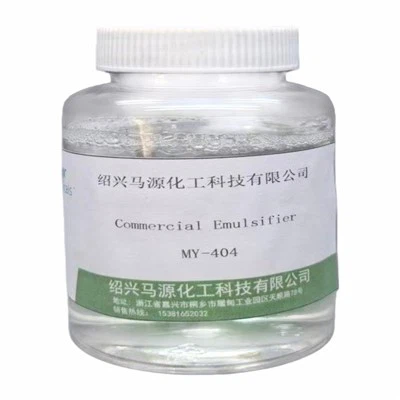
Now, let's talk about commercial emulsifiers. You can check out our Commercial Emulsifier on our website. These emulsifiers play a crucial role in microemulsions. They act as a bridge between the two immiscible liquids, like oil and water.
The basic principle behind how commercial emulsifiers work in microemulsions is all about reducing the surface tension between the two liquids. Surface tension is what makes oil and water want to separate. When you add an emulsifier, it has a unique structure. One part of the emulsifier molecule is hydrophilic (water - loving), and the other part is lipophilic (oil - loving).
The hydrophilic part of the emulsifier molecule attaches to the water phase, while the lipophilic part attaches to the oil phase. This creates a sort of barrier around the droplets of the dispersed phase. By doing so, it prevents the droplets from coming together and coalescing.
Let's take a closer look at the process. When you mix oil, water, and a commercial emulsifier, the emulsifier molecules start to arrange themselves at the interface between the oil and water. They form a monolayer around the oil droplets. This monolayer not only reduces the surface tension but also provides a steric or electrostatic repulsion between the droplets.
Steric repulsion occurs when the emulsifier molecules on the surface of the droplets physically prevent the droplets from getting too close to each other. Electrostatic repulsion, on the other hand, happens when the emulsifier molecules carry an electric charge. Droplets with the same charge will repel each other, keeping them dispersed in the continuous phase.
In microemulsions, the formation of these stable droplets is crucial. The small size of the droplets gives microemulsions some unique properties. They are often transparent or translucent, which is different from regular emulsions that are usually cloudy. This transparency makes them ideal for applications where appearance matters, such as in cosmetics and some food products.
Another important aspect is the solubility of the emulsifier. A good commercial emulsifier should be soluble in both the oil and water phases to effectively form and stabilize the microemulsion. Our Commercial Emulsifier is designed to have excellent solubility in a wide range of conditions, ensuring that it can create and maintain stable microemulsions.
Now, let's talk about some of the factors that can affect how commercial emulsifiers work in microemulsions. Temperature is one of the key factors. As the temperature changes, the solubility and the behavior of the emulsifier can change. For example, at higher temperatures, the emulsifier may become more soluble in the oil phase, which can affect the stability of the microemulsion.
The concentration of the emulsifier also plays a big role. If the concentration is too low, there won't be enough emulsifier molecules to form a stable monolayer around the droplets, and the microemulsion may break down. On the other hand, if the concentration is too high, it can lead to unwanted side effects, such as increased viscosity or changes in the appearance of the microemulsion.
The type of oil and water used also matters. Different oils have different chemical properties, and the emulsifier needs to be able to interact with them effectively. Similarly, the quality and composition of the water can affect the performance of the emulsifier. For instance, hard water with high mineral content may require a different type of emulsifier compared to soft water.
In addition to their role in microemulsions, our commercial emulsifiers can also be used in other applications. For example, we also offer a Moisture Eliminator for Windows and a Moisture - absorbing and Sweating Agent. These products work on similar principles of using functional additives to achieve specific goals.
If you're in the market for high - quality commercial emulsifiers or other functional additives, we'd love to hear from you. Whether you're in the food industry, cosmetics, or any other field that requires stable emulsions, our products can meet your needs. Contact us to start a discussion about your specific requirements and how our commercial emulsifiers can work for you.


In conclusion, commercial emulsifiers are essential for creating and maintaining stable microemulsions. Their unique structure and properties allow them to reduce surface tension, prevent droplet coalescence, and provide stability. By understanding how they work, you can make better use of these products in your applications.
References
- McClements, D. J. (2015). Food Emulsions: Principles, Practice, and Techniques. CRC Press.
- Becher, P. (1965). Emulsions: Theory and Practice. Reinhold Publishing Corporation.